Introduction
As global temperatures rise and extreme weather events become more frequent, cities are facing an increasingly serious environmental challenge: the urban heat island effect. Concrete buildings, asphalt roads, limited vegetation, and concentrated human activities make urban areas significantly warmer than surrounding rural regions. This additional heat affects public health, energy consumption, infrastructure, and the overall quality of urban life.
To address these challenges, urban planners, architects, environmental experts, and local governments are rethinking how cities are designed. From expanding green spaces to introducing reflective building materials, innovative urban design strategies are helping communities adapt to extreme temperatures.
The urban heat island response represents a broader movement toward climate-resilient cities that prioritize environmental sustainability, public well-being, and long-term adaptability.
Understanding the Urban Heat Island Effect
The urban heat island effect occurs when developed areas experience higher temperatures than nearby less-developed environments. This happens primarily because traditional urban materials absorb and retain large amounts of solar energy.
During the day, roads, rooftops, and buildings collect heat from sunlight. At night, these surfaces slowly release stored heat, preventing cities from cooling as efficiently as areas with natural vegetation.
Several factors contribute to urban heat islands:
- Dense construction: Buildings and paved surfaces replace natural landscapes that would otherwise absorb water and support cooling through evaporation.
- Limited vegetation: Fewer trees and plants mean reduced shade and evapotranspiration.
- Human activities: Vehicles, industrial operations, and air-conditioning systems release additional heat.
- Urban geometry: Tall buildings and narrow streets can trap heat and restrict airflow.
- Dark surfaces: Asphalt and certain roofing materials absorb more solar radiation than lighter alternatives.
These factors interact with local weather conditions, building density, and geography, creating temperature differences that vary considerably between neighborhoods.
Why Extreme Urban Heat Is Becoming a Major Concern
Extreme temperatures create challenges that extend far beyond physical discomfort. Prolonged exposure to excessive heat can contribute to dehydration, heat exhaustion, heatstroke, and worsening cardiovascular or respiratory conditions.
Older adults, young children, outdoor workers, and people with existing medical conditions are particularly vulnerable. Communities with limited access to trees, quality housing, and reliable cooling systems often experience greater risks.
Urban heat also increases electricity demand as households and businesses rely more heavily on air conditioning. During intense heatwaves, this demand can place additional pressure on electrical grids.
Transportation infrastructure faces similar challenges. High temperatures can damage road surfaces, affect railway operations, and reduce the efficiency of certain equipment.
As cities continue expanding, addressing these risks has become an essential part of climate adaptation planning.
1. Expanding Urban Green Spaces
One of the most effective natural responses to urban heat is increasing vegetation throughout developed environments.
Trees provide shade that reduces direct sunlight on sidewalks, roads, buildings, and public spaces. Their leaves also release moisture through transpiration, helping cool the surrounding air.
Cities are increasingly integrating vegetation into public infrastructure through urban forests, neighborhood parks, green corridors, and roadside planting programs.
The Benefits of Urban Greenery
Well-designed green spaces can provide multiple advantages beyond temperature reduction:
- Improved air quality and biodiversity
- More comfortable outdoor recreational areas
- Reduced stormwater runoff
- Better mental and physical well-being
- Greater neighborhood appeal and environmental quality
However, successful urban greening requires thoughtful planning. Selecting suitable tree species, providing sufficient soil space, and ensuring access to water are essential for long-term survival.
In regions facing drought, native and drought-tolerant vegetation can provide environmental benefits while reducing irrigation requirements.
2. Introducing Cool Roofs and Reflective Surfaces
Traditional dark rooftops absorb considerable amounts of sunlight, increasing building temperatures and contributing to local heat accumulation.
Cool roofs are designed to reflect more solar radiation and release absorbed heat efficiently. They commonly use reflective coatings, specialized membranes, or lighter-colored materials.
These systems can reduce rooftop temperatures and lower cooling requirements, particularly in buildings exposed to strong sunlight.
Cities are also experimenting with reflective pavements and lighter-colored construction materials.
Although reflective surfaces can help reduce heat absorption, their effectiveness depends on local conditions. Highly reflective pavement, for example, may increase sunlight reflected toward pedestrians if it is not combined with adequate shade.
For this reason, urban designers increasingly evaluate cool materials as part of integrated neighborhood cooling strategies rather than isolated solutions.
3. Transforming Buildings With Green Roofs and Vertical Gardens
Green roofs and vertical gardens are changing the appearance and environmental performance of modern buildings.
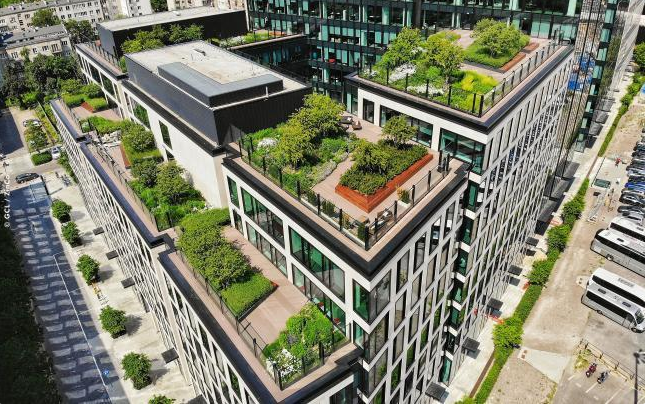
A green roof uses a layer of vegetation planted over a specially designed roofing system. Depending on its structure, it may support low-growing plants, grasses, shrubs, or more extensive rooftop landscapes.
These installations help moderate roof temperatures, absorb rainfall, and create additional habitats for urban wildlife.
Vertical gardens introduce plants along building exteriors, transforming otherwise exposed walls into vegetated surfaces.
Why Green Building Features Matter
Vegetated buildings can reduce direct solar exposure, support stormwater management, and improve outdoor visual environments.
However, their performance depends on appropriate waterproofing, structural capacity, maintenance, and plant selection.
Green roofs and living walls are most effective when integrated into broader sustainable building designs that include insulation, energy-efficient ventilation, and responsible water management.
4. Redesigning Streets for Pedestrian Comfort
Urban streets are often among the hottest parts of a city because they contain large areas of exposed asphalt and concrete.
Traditional road designs prioritize vehicle movement, sometimes leaving limited space for trees, shade structures, and pedestrian facilities.
Climate-responsive street planning introduces a different approach.
Urban designers are creating shaded sidewalks, planting tree-lined corridors, installing covered transit stops, and using permeable surfaces where suitable.
Some cities are also reducing unnecessary paved areas and converting selected road spaces into pedestrian plazas or neighborhood parks.
These improvements can make walking, cycling, and public transportation more comfortable during warm weather.
By reducing dependence on private vehicles, well-designed streets may also help limit emissions and traffic-related waste heat.
5. Using Water-Sensitive Urban Design
Water plays an important role in regulating temperatures within natural environments.
As cities become more densely developed, traditional drainage systems often direct rainwater away quickly, leaving surfaces dry and reducing opportunities for evaporative cooling.
Water-sensitive urban design attempts to restore some of these natural processes.
Strategies include rain gardens, bioswales, permeable pavements, stormwater retention systems, and vegetated drainage channels.
These features allow rainfall to be absorbed, stored, filtered, or reused more effectively.
Water features and misting systems can also provide localized cooling in public spaces, although their practicality depends on climate, water availability, operating costs, and maintenance.
In water-stressed regions, designers must balance heat reduction with conservation needs.
6. Creating Climate-Resilient Public Spaces
Public spaces are important parts of urban life, but extreme temperatures can make parks, playgrounds, shopping districts, and outdoor gathering areas difficult to use.
Cities are responding by introducing climate-responsive design principles into public infrastructure.
Shaded seating areas, covered walkways, drinking water stations, and strategically planted trees can improve comfort during hot weather.
Some communities establish accessible cooling centers during heatwaves, offering temporary relief to residents who lack effective cooling at home.
Public facilities can also be designed with ventilation, passive cooling, and reliable energy systems.
These interventions are particularly valuable in densely populated neighborhoods where private outdoor space is limited.
Creating comfortable public areas is not simply an architectural objective. It is also an important measure for supporting community health and social inclusion.
7. Using Smart Technology to Monitor Urban Heat
Advances in environmental monitoring are helping cities understand how temperature varies across different neighborhoods.
Satellite imagery, remote sensors, geographic information systems, and street-level measurements can reveal heat patterns that traditional citywide weather observations may overlook.
For example, temperatures may differ significantly between a neighborhood with mature trees and a nearby industrial district dominated by paved surfaces.
Urban planners can use these findings to identify vulnerable locations and prioritize cooling investments.
Data-Driven Climate Planning
Modern urban heat assessments may combine information about:
- Land surface temperatures
- Tree canopy coverage
- Building density and surface materials
- Population vulnerability
- Energy demand
- Access to public cooling facilities
Artificial intelligence and predictive modeling can also assist in evaluating potential design scenarios.
However, accurate heat planning requires reliable measurements and an understanding of the difference between surface temperatures and the air temperatures people experience.
Technology is most useful when it supports practical improvements and is combined with community knowledge.
8. Learning From Cities Already Adapting to Heat

Singapore: Integrating greenery into urban development
Singapore has promoted extensive urban greening through parks, street trees, and vegetation integrated into buildings. Its approach demonstrates how nature can become part of densely developed urban environments.

Medellín: Developing green corridors
Medellín has invested in interconnected green corridors along roads and waterways to expand vegetation and reduce heat exposure in selected urban areas.

Paris: Reimagining public spaces
Paris has pursued urban greening, schoolyard redesigns, and additional cooling measures as part of its response to increasingly challenging summer temperatures.
These examples show that urban heat adaptation does not follow a single model. Successful approaches reflect local climate, development patterns, available resources, and community needs.
9. Making Heat Adaptation More Equitable
Urban heat is not distributed equally.
Neighborhoods with fewer trees, extensive paved surfaces, poorly insulated housing, and limited access to cooling often experience greater exposure to extreme temperatures.
Lower-income residents may also face barriers to purchasing cooling equipment or paying increased electricity bills.
As a result, climate adaptation strategies must consider social equity alongside environmental performance.
Cities can prioritize vulnerable neighborhoods for tree planting, shaded transit stops, energy-efficient housing improvements, and public cooling facilities.
Community participation is particularly important because residents understand where heat creates practical problems in everyday life.
A successful urban heat island response should ensure that cooling benefits reach communities facing the greatest risks rather than concentrating improvements only in high-value commercial or residential districts.
10. The Challenges of Redesigning Existing Cities
Although climate-responsive urban planning offers significant opportunities, transforming established cities is not always straightforward.
Existing roads, underground utilities, dense buildings, and limited public land can restrict the introduction of new green infrastructure.
Large-scale renovations may also require substantial financial investment.
Maintenance is another important consideration. Trees need suitable growing conditions, green roofs require specialized care, and public cooling facilities need dependable resources.
Conflicts between different environmental objectives can also arise. For example, additional vegetation may require irrigation in dry climates, while certain construction materials may improve one aspect of thermal performance but create other environmental impacts.
To overcome these challenges, cities need long-term planning, coordinated policies, reliable funding, and regular performance assessments.
Rather than relying on one expensive transformation, many communities can achieve meaningful improvements through phased projects and targeted neighborhood investments.
The Future of Climate-Responsive Urban Design
The next generation of cities will likely place greater emphasis on adapting buildings, streets, and public spaces to changing environmental conditions.
Climate resilience is gradually becoming an important consideration in architecture, transportation planning, infrastructure investment, and public health policy.
Future urban development may increasingly incorporate passive cooling systems, connected green corridors, heat-resistant materials, renewable energy, and sophisticated environmental monitoring.
Urban planners may also rely more heavily on neighborhood-scale climate modeling to understand how individual design choices influence overall temperature patterns.
Importantly, heat adaptation must be coordinated with responses to flooding, drought, storms, and other extreme weather events.
A city that manages high temperatures but remains vulnerable to heavy rainfall or infrastructure disruptions cannot be considered fully climate-resilient.
Integrated planning will therefore become essential for building urban environments capable of responding to multiple climate risks.
Conclusion
The urban heat island effect is one of the most significant environmental challenges facing modern cities. As extreme heat becomes a growing concern, traditional urban development practices must evolve to protect residents, infrastructure, and local ecosystems.
Expanding green spaces, introducing cool roofs, improving street design, and incorporating smart environmental technology can all contribute to more comfortable and sustainable urban environments.
However, lasting progress requires more than individual construction projects. Effective heat adaptation depends on thoughtful planning, community participation, equitable investment, and long-term maintenance.
By redesigning cities around climate resilience and human well-being, urban communities can reduce heat-related risks while creating healthier, more welcoming spaces for future generations.
Read More : Restomodding: The Art of Injecting Modern Supercar Power into Vintage Bodies