Introduction
Technology has become an essential part of modern life, influencing how people communicate, work, travel, and manage their homes. Traditionally, interacting with technology required direct attention, whether through typing on a computer, tapping a smartphone, or navigating digital menus. However, a new technological approach is changing this relationship. Known as ambient computing, it allows digital systems to operate naturally within everyday environments, often without requiring constant human interaction.
Ambient computing represents a future where technology becomes less noticeable but more helpful. Instead of demanding attention, connected devices, sensors, and intelligent systems work together to anticipate needs, automate routine activities, and create personalized experiences.
As artificial intelligence, the Internet of Things (IoT), and smart devices continue to evolve, ambient computing is becoming an increasingly important part of the digital world.
What Is Ambient Computing?
Ambient computing refers to a technological environment where interconnected devices, sensors, and intelligent software operate continuously in the background to support human activities.
Unlike traditional computing, which relies heavily on screens and manual commands, ambient computing emphasizes natural interactions, contextual awareness, and automation.
For example, a smart home might automatically adjust its lighting based on available daylight, change the temperature according to occupancy, and activate security features when residents leave.
The goal is not simply to introduce more connected devices. It is to create an intelligent environment where technology understands relevant circumstances and responds appropriately.
How Ambient Computing Works
Ambient computing combines several technologies to create responsive and interconnected environments.
1. Artificial Intelligence and Machine Learning
Artificial intelligence plays an important role in interpreting information and identifying useful patterns.
Machine learning algorithms can analyze device activity, environmental conditions, and user preferences to support automated decisions.
For instance, an intelligent climate-control system might learn household temperature preferences and adjust its settings accordingly.
Over time, these systems can become more responsive to changing routines.
2. Internet of Things Connectivity
The Internet of Things connects physical objects to digital networks, allowing them to exchange information.
Smart appliances, wearable devices, lighting systems, security cameras, and environmental sensors can communicate to coordinate activities.
This connectivity creates the foundation for ambient computing by allowing multiple technologies to function as parts of a larger system.
3. Sensors and Contextual Awareness
Sensors allow computing systems to recognize conditions within their surroundings.
Motion detectors, temperature sensors, microphones, and light sensors provide information that helps devices determine appropriate responses.
For example, motion-sensitive lighting can illuminate a hallway when someone enters and switch off when the area becomes empty.
Contextual awareness reduces unnecessary interactions while improving convenience and energy efficiency.
4. Cloud and Edge Computing
Cloud computing provides resources for storing information, coordinating devices, and performing complex calculations.
Edge computing processes certain information closer to its source, potentially reducing response times and dependence on continuous cloud connectivity.
Combining these approaches helps ambient systems respond efficiently while supporting applications with different performance and privacy requirements.
Everyday Examples of Ambient Computing
Ambient computing is already visible in several aspects of daily life.
Smart Homes and Automated Living
12
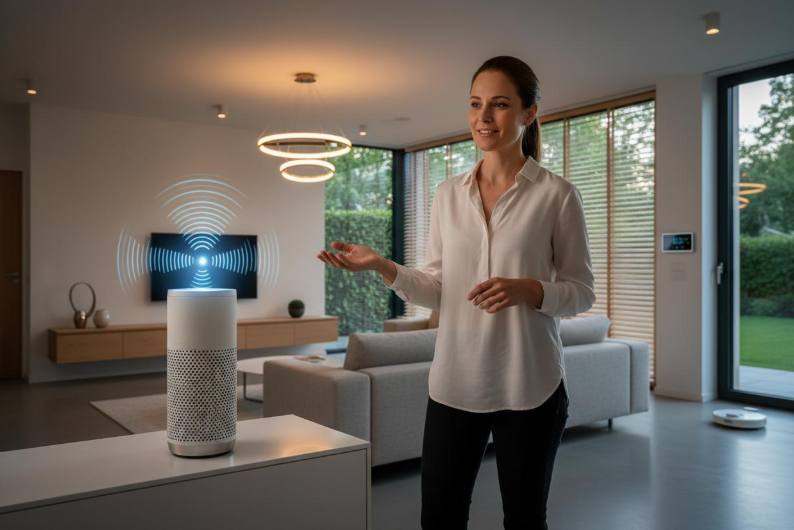
Smart homes offer some of the clearest examples of ambient computing.
Connected thermostats can regulate indoor temperatures, intelligent lighting systems can respond to occupancy, and smart appliances can provide reminders about maintenance requirements.
When these devices work together, household routines become easier to manage.
For example, a coordinated evening routine could dim the lights, adjust the thermostat, and activate selected security settings through a single automated sequence.
Wearable Technology and Health Monitoring
Wearable devices demonstrate how computing can become part of ordinary activities.
Smartwatches and fitness trackers can monitor movement, sleep patterns, and certain physiological measurements.
These devices provide information without requiring users to repeatedly enter data manually.
Ambient health technologies may also support remote monitoring and timely reminders, although their accuracy and medical usefulness depend on the particular device and application.
Intelligent Transportation
Modern vehicles increasingly incorporate ambient computing features.
Automatic climate adjustments, adaptive lighting, driver-assistance systems, and personalized infotainment settings are examples of technology responding to changing conditions.
Connected transportation systems can also exchange relevant information with infrastructure and navigation services.
These capabilities can improve comfort and awareness, although automated assistance does not eliminate the need for attentive driving.
Smart Workplaces
Ambient computing can make offices more responsive to employee needs.
Occupancy sensors may automatically control lighting and ventilation, while connected meeting-room systems can coordinate displays and conferencing equipment.
Workplaces can also use environmental data to manage energy consumption and improve space utilization.
When implemented carefully, these solutions allow employees to focus more on their responsibilities and less on managing surrounding technology.
Major Benefits of Ambient Computing
Greater Convenience
One of the strongest advantages of ambient computing is its ability to reduce repetitive manual tasks.
Automated systems can handle routine adjustments, reminders, and device coordination.
This convenience allows people to spend less time operating technology and more time concentrating on meaningful activities.
Improved Energy Efficiency
Intelligent systems can reduce unnecessary energy consumption by adjusting devices according to actual requirements.
For example, smart lighting can switch off in unoccupied rooms, while connected heating systems can avoid maintaining the same temperature throughout an empty building.
The potential savings depend on system design, user behavior, and the energy consumed by the technology itself.
Personalized Digital Experiences
Ambient computing can adapt environments to individual preferences.
A smart workspace might remember preferred lighting conditions, while a connected vehicle could restore a driver’s saved comfort settings.
Personalization can make technology feel more natural and responsive without requiring repeated configuration.
Better Accessibility
Ambient computing can support people who find conventional interfaces difficult to operate.
Voice commands, automated lighting, simplified controls, and assistive notifications can reduce certain physical or cognitive barriers.
Thoughtfully designed systems can make homes and workplaces more accessible to older adults and people with disabilities.
Challenges and Concerns Surrounding Ambient Computing
Despite its advantages, ambient computing introduces important challenges.
Privacy and Data Protection
Devices that continuously observe environmental conditions may collect sensitive information.
Microphones, cameras, location-aware services, and behavioral analytics can create significant privacy risks if their data is handled poorly.
Manufacturers and service providers must prioritize transparent data practices, meaningful user consent, and strong protection against unauthorized access.
Cybersecurity Risks
Interconnected devices can introduce additional opportunities for cyberattacks.
A poorly secured connected appliance may become an entry point into a larger network.
Regular software updates, secure authentication, device isolation, and encryption are important safeguards.
Device Compatibility
Different manufacturers often use separate ecosystems and communication standards.
Compatibility problems can prevent devices from working together effectively, weakening the seamless experience ambient computing promises.
Interoperability standards and consistent software support are important for building reliable connected environments.
Loss of User Control
Automation can become frustrating when systems make incorrect assumptions about personal preferences.
Users should be able to understand why an action occurred, override automated decisions, and disable features they do not want.
The most successful ambient environments will balance intelligent assistance with clear human control.
The Role of Artificial Intelligence in the Future of Ambient Computing
Artificial intelligence is expected to play an increasingly important role in making ambient computing more adaptive.
Rather than following only predefined instructions, future systems may interpret combinations of signals to recognize relevant situations.
For example, a connected home could coordinate lighting, temperature, and selected appliances according to a resident’s routine and current conditions.
Advances in natural language processing may also make interactions more conversational, reducing dependence on complicated interfaces.
However, intelligent predictions will not always be correct. Reliable ambient computing will require safeguards against errors, clear explanations where appropriate, and options for users to approve consequential actions.
How Ambient Computing Could Transform Different Industries
The influence of ambient computing extends beyond individual households.
In healthcare, connected monitoring systems may help professionals observe selected patient conditions outside traditional clinical environments.
In retail, intelligent environments could support inventory tracking, customer assistance, and more efficient store operations.
Manufacturing facilities may use sensors and automated monitoring to identify equipment problems before they cause serious disruptions.
Educational institutions could incorporate responsive lighting, environmental monitoring, and accessible digital tools to improve learning spaces.
Across these sectors, the value of ambient computing will depend on whether it solves practical problems without creating unnecessary complexity.
Building a Responsible Ambient Computing Future
For ambient computing to become widely trusted, convenience must be accompanied by responsible design.
Developers should minimize unnecessary data collection, protect personal information, and provide understandable privacy settings.
Systems should also be designed to remain useful when internet connectivity fails or individual devices become unavailable.
Accessibility, affordability, repairability, and long-term software support deserve attention because connected environments should remain practical beyond their initial installation.
Most importantly, technology should support human decisions rather than silently replacing them.
A truly intelligent environment is one that understands when to offer assistance and when to remain inactive.
Conclusion
Ambient computing represents an important shift in the relationship between people and digital technology. Instead of relying entirely on visible screens and deliberate commands, intelligent devices can become integrated into homes, workplaces, vehicles, and public environments.
Through artificial intelligence, connected sensors, automation, and contextual awareness, ambient computing has the potential to simplify daily routines, improve accessibility, and support more efficient resource use.
However, its long-term success will depend on privacy, security, compatibility, and meaningful user control.
As these technologies continue to develop, the future of computing may be defined not by how frequently people interact with devices, but by how effectively those devices assist them without demanding attention.
Read More :Fractional Leadership: Why Startups Are Renting C-Suite Executives