Introduction
Art has always evolved alongside technology, reflecting changes in human imagination, culture, and innovation. From traditional stone carving to modern 3D printing, sculpture has continuously embraced new tools and techniques. Today, artificial intelligence (AI) is introducing another significant transformation, challenging conventional ideas about how sculptures are designed, created, and experienced.
AI is no longer limited to digital images, automated systems, or data analysis. It is becoming a valuable creative partner for contemporary sculptors, helping them experiment with complex shapes, unconventional materials, and interactive installations. This growing relationship between technology and artistic expression is expanding the possibilities of sculpture beyond traditional physical forms.
The Evolution of Sculpture in the Digital Age
Traditionally, sculpture has involved shaping materials such as marble, wood, clay, bronze, and metal into three-dimensional artworks. Artists relied on their technical skills, physical tools, and creative vision to transform raw materials into meaningful objects.
The introduction of computer-aided design (CAD), digital modeling, and 3D printing began changing this process. Sculptors gained the ability to develop detailed digital models before producing physical pieces.
Artificial intelligence takes this evolution further by offering intelligent design suggestions, generating intricate structures, and helping artists explore possibilities that might be difficult to imagine manually.
Rather than replacing traditional craftsmanship, AI provides additional methods for experimentation and creative discovery.
How Artificial Intelligence Is Transforming Sculptural Design
One of AI’s most important contributions to contemporary sculpture is its ability to assist with the creative design process.
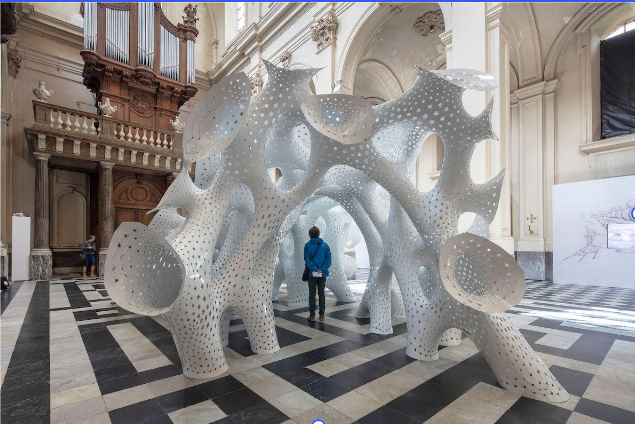
AI-powered generative design systems can evaluate parameters established by artists, such as dimensions, structural requirements, material properties, and visual preferences. These systems can then produce multiple design variations based on the provided information.
For example, an artist interested in creating an abstract sculpture inspired by natural formations could use AI tools to explore structures resembling coral reefs, tree branches, or flowing water.
This approach makes it possible to investigate highly complex geometries while maintaining control over the artwork’s overall artistic direction.
AI also encourages experimentation because artists can quickly compare different forms, modify proportions, and explore unexpected combinations of shapes.
Generative Art and the Rise of Algorithmic Sculpture
Generative art represents an important connection between artificial intelligence and contemporary sculpture.
In generative sculpture, artists establish rules, datasets, or computational processes that influence the final design. AI systems can help identify patterns, generate variations, and produce forms based on these inputs.
Unlike traditional sculpting, where the artist directly controls every physical adjustment, generative processes introduce elements of computational exploration.
Some artists use mathematical patterns to develop intricate structures, while others incorporate environmental information, movement data, or biological inspiration.
The resulting sculptures may feature fluid surfaces, interconnected structures, or asymmetrical compositions that challenge conventional artistic expectations.
This approach raises an interesting question about creativity: when an algorithm contributes to the design, where does the artistic vision originate?
For many contemporary artists, the answer lies in collaboration. The human creator defines the purpose, evaluates the results, and determines how technology contributes to the final artwork.
Combining AI With 3D Printing and Advanced Manufacturing

One of the most practical applications of AI in sculpture involves combining computational design with modern manufacturing technologies.
AI-assisted design software can generate complicated three-dimensional structures that can be prepared for production using 3D printing, CNC machining, or robotic fabrication.
These technologies offer several advantages for contemporary sculptors.
First, they allow artists to create intricate forms that may be difficult or time-consuming to produce entirely by hand.
Second, digital prototyping makes it easier to test ideas before committing expensive materials to a final artwork.
Third, advanced manufacturing supports experimentation with materials such as recycled plastics, engineered composites, metals, and specialized resins.
However, producing an AI-generated design still requires practical knowledge of physical construction. Artists must consider weight distribution, stability, material strength, and manufacturing limitations.
The combination of computational creativity and physical craftsmanship creates opportunities for artworks that merge technical precision with emotional expression.
Interactive Sculptures That Respond to Their Environment
Artificial intelligence is also changing how audiences experience contemporary sculpture.
Traditional sculptures are generally static objects that viewers observe from different angles. AI-enabled installations, however, can incorporate sensors, cameras, sound systems, lighting, and mechanical movement to create responsive experiences.
For instance, an interactive sculpture might change its lighting patterns when visitors approach, respond to surrounding sounds, or adjust its movement according to environmental conditions.
AI systems can analyze sensor information and help determine how the installation responds.
These capabilities transform viewers from passive observers into active participants.
The artwork becomes an evolving experience influenced by human interaction rather than a completely fixed physical object.
Such installations are especially relevant in contemporary museums, public spaces, and exhibitions focused on the relationship between people and technology.
AI and the Exploration of New Artistic Materials
Material experimentation has always played an important role in sculpture.
Contemporary artists regularly investigate unconventional substances, combining traditional materials with industrial components and emerging technologies.
AI can contribute to this process by assisting with material selection, evaluating structural properties, and supporting design optimization.
For example, computational tools may help artists identify ways to reduce unnecessary material while maintaining the structural integrity of a sculpture.
This approach can be useful for large installations where weight, transportation, and construction costs become significant considerations.
AI-assisted workflows can also complement research into biodegradable materials, recycled components, and resource-efficient manufacturing.
Although AI does not automatically make sculpture sustainable, careful integration of these technologies can support more responsible artistic production.
Expanding Creative Accessibility
Another important development is the potential for AI to make certain sculptural design processes more accessible.
Previously, producing complex digital sculptures often required extensive experience with specialized modeling software.
AI-assisted tools can simplify some technical tasks by helping users generate preliminary forms, visualize concepts, or experiment with three-dimensional compositions.
Emerging text-to-3D and image-to-3D systems also provide new ways to develop initial design concepts.
For emerging artists, these tools may reduce technical barriers and encourage experimentation.
However, accessibility does not eliminate the importance of artistic education. Understanding composition, materials, spatial relationships, and physical construction remains essential for creating successful sculptures.
AI is most useful when it supports artistic knowledge rather than replacing it.
The Debate Over Creativity and Artistic Ownership
The growing use of artificial intelligence in sculpture has also generated debate.
One major concern involves artistic authorship. When an AI system contributes significantly to the appearance of a sculpture, questions arise about who deserves recognition for the final design.
Another issue involves intellectual property. AI models trained on existing creative works may raise concerns about permission, originality, and the influence of other artists’ work.
There are also questions about the emotional authenticity of AI-assisted art.
Traditional sculpture is often appreciated for the artist’s personal effort, craftsmanship, and individual interpretation. Some critics worry that increasing automation could reduce the visibility of these qualities.
Supporters of AI-assisted art argue that technology is simply another creative instrument, comparable to photography, digital modeling, or mechanical fabrication.
Ultimately, the artistic value of a sculpture depends on more than the technology used to produce it. Concept, intention, originality, craftsmanship, and audience interpretation all contribute to its meaning.
The Future of AI in Contemporary Sculpture
As artificial intelligence continues to develop, its role in sculpture is likely to become increasingly diverse.
Future applications may include more sophisticated robotic fabrication, adaptive public installations, intelligent material optimization, and sculptures that combine physical structures with augmented reality.
Artists may also use AI to explore designs influenced by real-time environmental data, allowing installations to change according to weather conditions, movement, or visitor activity.
Another promising direction involves combining traditional craftsmanship with computational design.
A sculptor might begin with hand-drawn sketches, develop multiple structural possibilities using AI, and then complete the physical artwork through conventional carving or casting.
This combination preserves the personal character of handmade art while introducing new opportunities for experimentation.
The future of contemporary sculpture is therefore unlikely to belong exclusively to either machines or traditional artists. Instead, it may emerge through meaningful collaboration between human imagination and advanced technological tools.
Conclusion
Artificial intelligence is expanding the boundaries of contemporary sculpture by introducing new design possibilities, production techniques, and interactive experiences.
From generative structures and 3D printing to responsive installations and innovative material applications, AI is influencing how artists conceptualize and produce three-dimensional artwork.
Despite these developments, human creativity remains central to artistic expression. Technology can generate possibilities, but artists provide meaning, intention, interpretation, and emotional depth.
As contemporary sculpture continues evolving, the combination of human imagination and artificial intelligence offers opportunities to create artworks that challenge expectations and redefine the relationship between art, technology, and the physical world.
Read More : Funny Dirty Names: 500+ Cheeky, Naughty & Hilarious Ideas 😏