
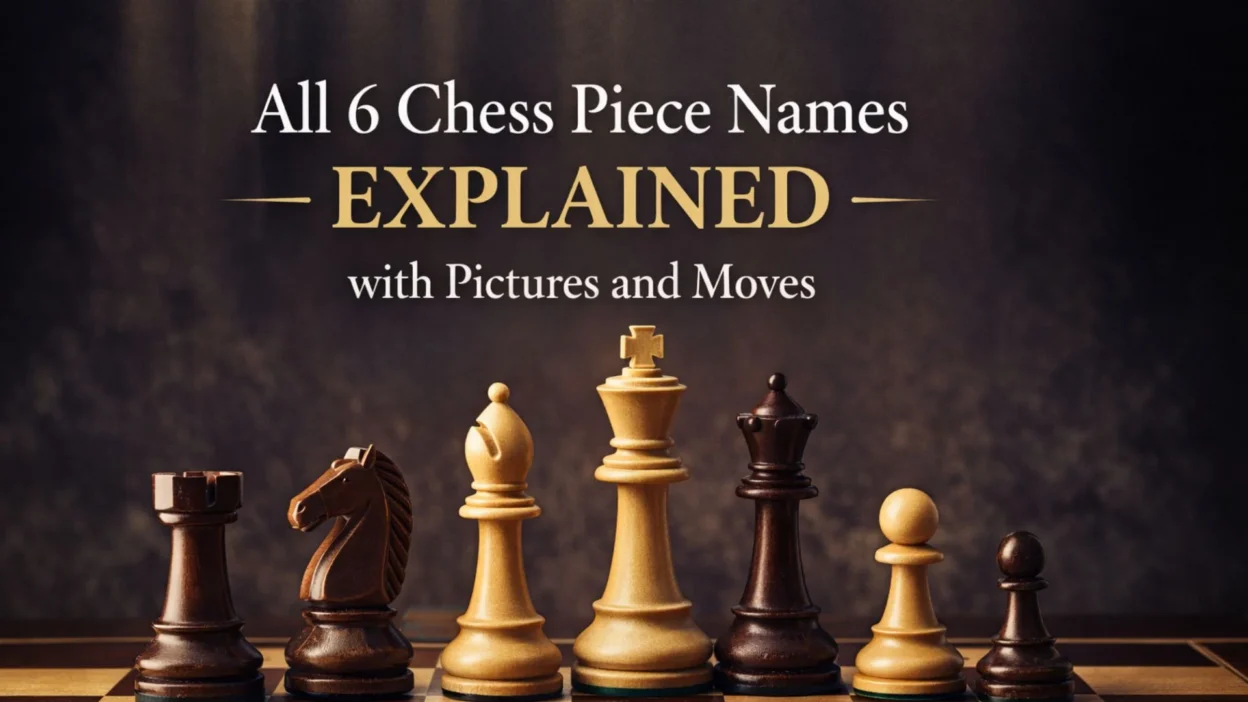
Learning the chess pieces names is the first step to playing the game. I have taught beginners for years, and the most common question is always about what each piece is called and how it moves. The good news is that there are only six different chess piece names to learn. Each one has a unique movement pattern and a specific value. This guide covers every chess piece name, how it moves, how much it is worth, and tips for using it effectively.
What Are Chess Pieces Names?
Chess pieces names are the titles given to the six different types of pieces used in the game of chess. Each name describes a specific role on the board. The six chess pieces are the king, queen, rook, bishop, knight, and pawn. Every player starts with 16 pieces. One king, one queen, two rooks, two bishops, two knights, and eight pawns. The names come from medieval warfare and society, representing different ranks and roles in battle.
The King (The Most Important Piece)

The king is the most important chess piece. If your king is captured, you lose the game. The king moves one square in any direction. Up, down, left, right, or diagonal. It cannot move into a square where it would be captured. This is called moving into check. The king has a special move called castling. Castling is the only time the king can move two squares. It moves two squares toward a rook, and the rook jumps over to the other side.
Value: Priceless (you cannot trade the king)
- King moves one square in any direction
- King cannot move into check
- Castling is the only double move
- White king starts on e1
- Black king starts on e8
- King can capture any enemy piece adjacent
- King cannot move onto a square attacked by enemy
- King can help defend pieces late game
- King becomes active in endgame
- Never move your king out early for no reason
The Queen (The Most Powerful Piece)

The queen is the most powerful chess piece. She can move any number of squares in any direction. Horizontally, vertically, or diagonally. The queen combines the movement of the rook and the bishop. This makes her incredibly dangerous. Losing your queen is usually a disaster unless you get something equally valuable in return. The queen is worth nine points.
Value: 9 points
- Queen moves any number of squares in any direction
- Queen combines rook and bishop movement
- White queen starts on d1
- Black queen starts on d8
- Queen starts on her own color (white on white, black on black)
- Queen is strongest in open positions
- Queen can checkmate with a king alone
- Never bring queen out too early (she becomes a target)
- Queen can be sacrificed for a winning attack
- Protect your queen with other pieces
The Rook (The Castle Piece)
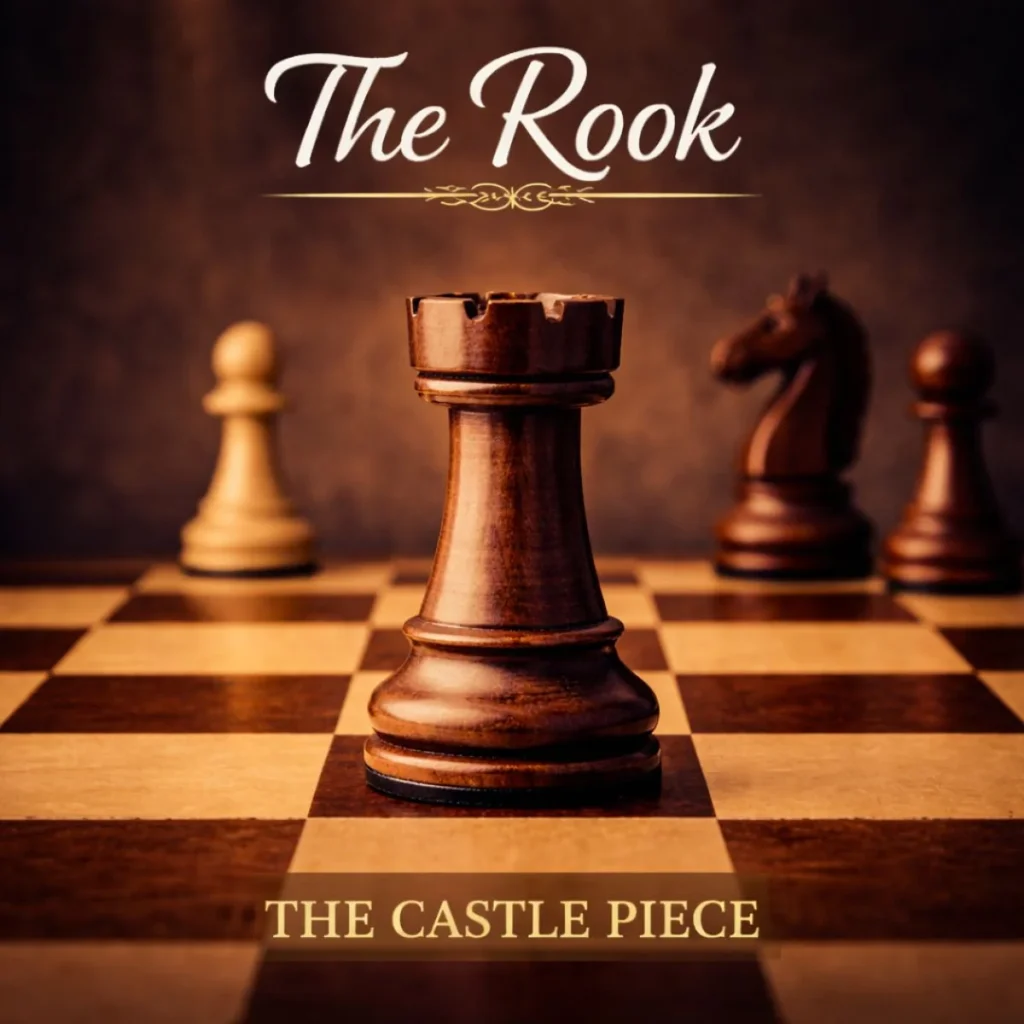
The rook looks like a castle tower. It moves any number of squares horizontally or vertically. The rook cannot move diagonally. Rooks are most powerful when they are on open files (columns with no pawns). Two rooks together are very strong. Rooks are worth five points each. You start with two rooks, one on each corner of the board.
Value: 5 points
- Rook moves any number of squares horizontally or vertically
- Rook cannot move diagonally
- White rooks start on a1 and h1
- Black rooks start on a8 and h8
- Rooks are strongest on open files
- Two rooks can checkmate a lone king
- Rook is worth less than a queen but more than a bishop or knight
- Rooks work well together on the seventh rank
- Castling moves the rook next to the king
- Rooks need open lines to be effective
The Bishop (The Diagonal Mover)
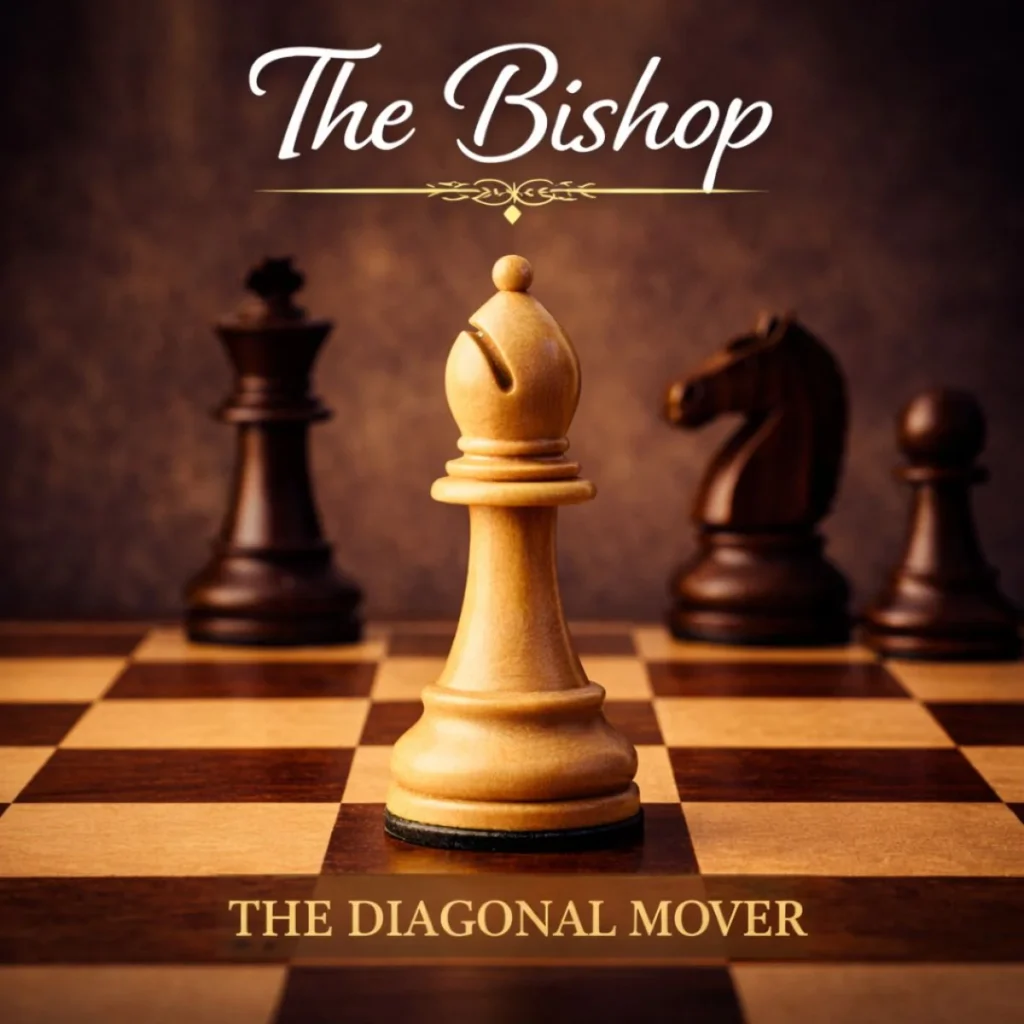
The bishop moves any number of squares diagonally. It stays on the same color square for the entire game. Each bishop is either a light square bishop or a dark square bishop. You start with two bishops, one on each color. Bishops are worth three points each. They are strongest in open positions where diagonals are clear.
Value: 3 points
- Bishop moves any number of squares diagonally
- Bishop stays on same color square forever
- White bishops start on c1 and f1
- Black bishops start on c8 and f8
- Light square bishop stays on light squares
- Dark square bishop stays on dark squares
- Two bishops together are stronger than two knights
- Bishops are great for long range attacks
- Bishops struggle in closed positions with many pawns
- Trade a bishop for a knight only if it helps your position
The Knight (The Jumper)

The knight moves in an L shape. Two squares in one direction, then one square perpendicular. The knight is the only piece that can jump over other pieces. This makes it very useful in crowded positions. Knights are worth three points each, the same as bishops. You start with two knights. Knights are best in closed positions where other pieces cannot move freely.
Value: 3 points
- Knight moves two squares then one square perpendicular
- Knight jumps over other pieces
- Knight always moves to opposite color square
- White knights start on b1 and g1
- Black knights start on b8 and g8
- Knight forks (attacking two pieces at once) are powerful
- Knights are strong in closed positions
- Knight takes time to move across the board
- A knight on the rim is dim (edge squares limit moves)
- Knights control eight squares in the center
The Pawn (The Foot Soldier)

The pawn is the smallest and most numerous piece. You start with eight pawns. Pawns move forward one square, but capture diagonally. On their first move, pawns can move forward two squares. Pawns cannot move backward. They are worth one point each. When a pawn reaches the other side of the board, it promotes to any piece except another king. Most players promote to a queen.
Value: 1 point
- Pawn moves forward one square
- Pawn captures diagonally forward
- Pawn can move two squares on first move
- En passant is a special pawn capture
- Pawn promotes when reaching the last rank
- Most pawns promote to queen
- Pawns cannot move backward
- Pawn structure determines the whole game
- Doubled pawns are weak
- Isolated pawns are also weak
Special Pawn Moves (En Passant and Promotion)
Pawns have two special moves that beginners often miss. En passant is a French term meaning “in passing.” If an enemy pawn moves two squares forward and lands next to your pawn, you can capture it as if it only moved one square. You must do this immediately on the next move. Promotion happens when a pawn reaches the opposite side of the board. It can become a queen, rook, bishop, or knight. Almost always choose a queen because she is the strongest.
- En passant capture must happen immediately
- En passant only works on the next move
- Promotion happens on the last rank
- Queen is the best promotion choice usually
- Sometimes promotion to knight creates a check
- Promotion to rook avoids stalemate
- Promotion to bishop is rarely useful
- You can have multiple queens
- Promoted pawn changes piece immediately
- The pawn is removed and new piece appears
How To Remember Chess Pieces Names
A simple way to remember the chess pieces names is from the center outward. The king and queen are in the middle. Next to them are the bishops. Next to the bishops are the knights. On the corners are the rooks. In front of all of them are the pawns. The queen always starts on her own color. White queen on white square (d1). Black queen on black square (d8). This is a common mnemonic that helps beginners set up the board correctly every time.
- Queen starts on her own color
- White queen on white square
- Black queen on black square
- King starts next to the queen
- Bishops next to king and queen
- Knights next to bishops
- Rooks in the corners
- Pawns in the second rank
- Back rank has all major pieces
- Pawn rank is in front of them
Chess Piece Values Explained
Understanding piece values helps you decide when to trade pieces. A queen is worth nine points. A rook is worth five points. Bishops and knights are worth three points each. Pawns are worth one point each. The king is priceless. These values are guidelines, not absolute rules. A knight in the center controlling eight squares is more valuable than a bishop trapped behind its own pawns. But in general, avoid trading a higher value piece for a lower value piece unless you get a winning attack.
- Queen equals nine pawns
- Rook equals five pawns
- Bishop equals three pawns
- Knight equals three pawns
- Pawn equals one point
- King has no numerical value
- Two rooks are stronger than a queen
- Bishop and knight together are worth more than a rook
- Three pawns are worth more than a bishop or knight
- Piece values change based on position
Starting Position of Each Chess Piece
The starting position is the same for every chess game. White pieces start on ranks 1 and 2. Black pieces start on ranks 7 and 8. The back rank from left to right is rook, knight, bishop, queen, king, bishop, knight, rook. The pawns fill the entire second rank. This setup is symmetrical except the king and queen are reversed for black. White queen is on d1, a light square. Black queen is on d8, a dark square. Remembering this setup takes practice, but it becomes automatic quickly.
- White back rank is rank 1
- Black back rank is rank 8
- White pawns are on rank 2
- Black pawns are on rank 7
- Rooks go in the corners
- Knights next to rooks
- Bishops next to knights
- Queen on her own color
- King next to queen
- Pawns fill the entire second rank
How To Set Up Chess Pieces Correctly
Setting up the board correctly is the first skill every chess player learns. Place the board so a light square is in the bottom right corner. Put the rooks in the corners. Next to them put the knights. Next to the knights put the bishops. Put the queen on her own color. Put the king on the remaining square. Fill the second rank with pawns. Repeat for black pieces on the opposite side. The board should be symmetrical except for the king and queen positions. Double check that the queens are on their own colors before starting.
- Light square in bottom right corner
- Rooks in corners first
- Knights next to rooks
- Bishops next to knights
- Queen on her own color
- King on remaining square
- Pawns on the second rank
- Black pieces opposite white pieces
- White queen on light square
- Black queen on dark square
How Chess Pieces Move Summary
Each chess piece moves differently. The king moves one square in any direction. The queen moves any number of squares in any direction. The rook moves any number of squares horizontally or vertically. The bishop moves any number of squares diagonally. The knight moves in an L shape and jumps. The pawn moves forward one square and captures diagonally. Learning these movement patterns is essential. Practice each piece individually until the moves become automatic.
- King moves one square any direction
- Queen moves any number any direction
- Rook moves any number straight
- Bishop moves any number diagonal
- Knight moves in L shape
- Knight jumps over pieces
- Pawn moves forward one
- Pawn captures diagonally
- Pawn moves two on first move
- No piece except knight jumps
How Chess Pieces Capture
All chess pieces capture the same way they move. A king captures by moving onto an enemy piece’s square. A queen captures by landing on an enemy piece. A rook captures by moving onto an enemy piece. A bishop captures by moving onto an enemy piece. A knight captures by landing on an enemy piece. A pawn captures diagonally forward, not straight forward. Captured pieces are removed from the board. You cannot capture your own pieces. You cannot capture the king. The game ends when the king is in checkmate, not captured.
- Capture works same as movement
- Pawn captures diagonally only
- Pawn does not capture straight forward
- Captured pieces leave the board
- Cannot capture your own pieces
- Cannot move through your own pieces
- Knights jump over pieces
- King cannot capture into check
- Queen captures everything in her path
- Rooks capture along straight lines
How To Pronounce Chess Pieces Names
Some chess piece names are easy to pronounce. King, queen, rook, bishop, knight, and pawn are all common English words. The tricky one is “knight.” The K is silent. It sounds exactly like “night.” Some beginners say “kuh-night” but that is incorrect. The correct pronunciation is “nite.” The word “pawn” rhymes with “lawn” or “dawn.” Not “pahn” or “pon.” Practice saying each name out loud. The names are simple once you know them.
- Knight has a silent K
- Knight sounds like night
- Pawn rhymes with lawn
- Pawn does not sound like pond
- Rook rhymes with book
- Rook does not sound like rock
- Bishop has a short i sound
- Queen rhymes with green
- King has a hard K sound
- All names are one syllable except bishop
Frequently Confused Chess Pieces
Beginners often confuse the knight and the bishop. Both are worth three points, but they move completely differently. The knight jumps in an L shape and can jump over pieces. The bishop slides diagonally and cannot jump. Another common confusion is the rook and the queen. The queen moves like a rook and bishop combined. The rook only moves straight. The king and queen are also confused because they sit next to each other. Remember the queen starts on her own color. That helps identify which is which.
- Knight jumps, bishop slides
- Knight changes square color every move
- Bishop stays on same color
- Queen moves like rook plus bishop
- Rook only moves straight
- Queen is more valuable than rook
- King and queen sit next to each other
- Queen on her own color
- King starts next to queen
- King is the tallest piece usually
Chess Pieces Names in Other Languages
Chess is played all over the world. Different languages have different names for the pieces. In many languages, the rook is called a tower or castle. The bishop is often called an elephant or runner. The knight is called a horse in many languages. The queen is sometimes called a vizier or minister. The king is usually called the king in most languages. The pawn is often called a farmer or foot soldier. Knowing these names can help if you play chess with people from other countries.
- Rook is castle in many languages
- Bishop is elephant in Russian
- Bishop is runner in German
- Knight is horse in many languages
- Queen is vizier in Arabic
- Queen is minister in some languages
- Pawn is farmer in German
- Pawn is foot soldier in French
- King is king in most languages
- Names vary by culture but pieces move the same
History of Chess Pieces Names
The names of chess pieces come from medieval warfare and society. The king and queen represent royalty. The rook represents a castle or chariot. The bishop represents the church. The knight represents cavalry. The pawn represents foot soldiers. The game originated in India as chaturanga, which means four divisions of military. Infantry, cavalry, elephants, and chariots. When the game spread to Europe, the names changed to fit European society. Elephants became bishops. Chariots became rooks. The queen became more powerful in Europe than in the original game.
- Chess originated in India
- Original pieces were military units
- Elephants became bishops
- Chariots became rooks
- Cavalry became knights
- Infantry became pawns
- King was always king
- Queen became stronger in Europe
- The game spread through Persia and Arabia
- European names stuck in English
Chess Piece Nicknames Players Use
Experienced chess players use nicknames for pieces. The queen is often called “the lady.” The rook is called “the castle.” The knight is called “the horse.” The bishop is sometimes called “the preacher.” Pawns are called “foot soldiers” or just “pawns.” The king is usually just “the king.” These nicknames are not official, but you will hear them in chess clubs and online. They help beginners remember the pieces. Calling a knight a horse is fine for casual play, but learn the official names too.
- Queen is called the lady
- Rook is called the castle
- Knight is called the horse
- Bishop is called the preacher sometimes
- Pawns are called foot soldiers
- King is just the king
- Nicknames are not official
- Official names are king, queen, rook, bishop, knight, pawn
- Use nicknames casually
- Learn official names for tournaments
Chess Piece Symbols and Notation
In chess notation, each piece has a symbol or letter. King is K. Queen is Q. Rook is R. Bishop is B. Knight is N (K is already used for king). Pawn has no letter. In move notation, you write the piece letter followed by the square. Nf3 means knight moves to f3. e4 means pawn moves to e4. Captures use an x. Nxf3 means knight captures on f3. Check uses a plus sign. Qh5+ means queen checks on h5. Checkmate uses a hash symbol or double plus. Learning notation helps you read chess books and play online.
- King is K in notation
- Queen is Q in notation
- Rook is R in notation
- Bishop is B in notation
- Knight is N in notation (K is king)
- Pawn has no letter
- x means capture
- Plus means check
- Hash means checkmate
- e4 means pawn to e4
FAQs
What are the 6 chess pieces names?
The six chess pieces names are king, queen, rook, bishop, knight, and pawn. Each player starts with one king, one queen, two rooks, two bishops, two knights, and eight pawns.
Which chess piece is the most powerful?
The queen is the most powerful chess piece. She can move any number of squares in any direction. She is worth nine points. The king is the most important piece, but not the most powerful.
Which chess piece is the least powerful?
The pawn is the least powerful chess piece. It is worth one point. Pawns move forward one square and capture diagonally. But pawns can become queens if they reach the other side of the board.
Why is the knight called a horse?
The knight is often called a horse because its piece looks like a horse’s head. The official name is knight, but many casual players call it a horse. The knight moves in an L shape and can jump over other pieces.
What is the rarest chess move?
En passant is the rarest chess move. Many casual players do not even know it exists. It happens when a pawn moves two squares forward and an enemy pawn captures it as if it only moved one square. The capture must happen immediately on the next move.
Conclusion
Now you know all six chess pieces names and how they move. King, queen, rook, bishop, knight, pawn. Each one has a unique role. The king is the target. The queen is the powerhouse. The rooks control the open files. The bishops control the diagonals. The knights jump over everything. The pawns are the foot soldiers that can become queens. So here is your challenge. Set up a board right now. Name every piece out loud as you put it in place. Then play a game. Every time you move a piece, say its name. King to e2. Knight to f3. Pawn to e4. Do this until the names feel automatic. That is how you learn. Not by reading. By playing.